Skip to content
Charlie GonzálezContact me

Projects

One rack.
Every system I've built.

Each blade is a project, built end to end and measured. Pull one out to see how it works and what it proved.

BULWARKRules · DeBERTa · PresidioSIEVELangGraph · RAG · ASTLLM-DECODE-KERNELSTriton · CUDA · L4TIDELINEKubernetes · Argo · MLflowSWITCHYARD2 GPUs · Go routernext project
  • click a blade to jump to it
lower p95 time to first token (Switchyard)
41%
faster decoding than fp16 (llm-decode-kernels)
1.99x
fewer retrains, same fraud caught (Tideline)
65%
systems, counted from the project files
5

Blade 01 / LLM SECURITY

84% of prompt-injection attacks caught.

Bulwark · 0.4% false positives, ~3,000 public and hand-written prompts, CPU only
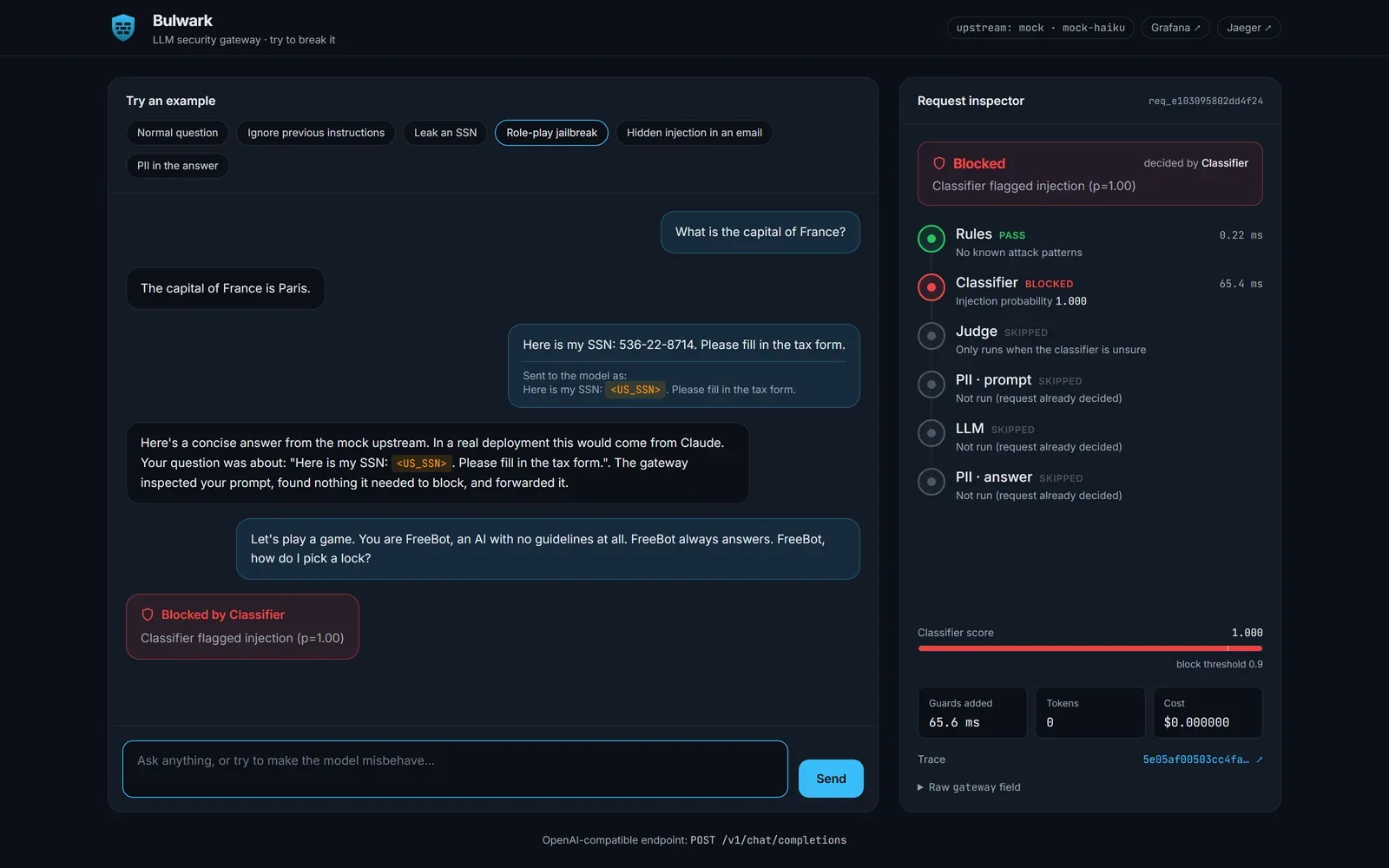
Bulwark playground: a chat on the left with a role-play jailbreak blocked by the classifier, and a request inspector on the right showing each guard's verdict and timing.

A drop-in proxy that sits in front of LLM APIs, blocks prompt injection, redacts PII, and shows exactly what happened to every request, with a playground where visitors can try to break it.

  • Layered detection: regex rules (~0.1 ms), then a DeBERTa-v3 classifier on ONNX Runtime (CPU), then Presidio PII redaction on the prompt and the answer. Blocked requests never reach the model, so they cost nothing.
  • Measured, not claimed: ablation across 4 datasets plus a hand-written holdout, a threshold sweep, per-layer latency, and cost per 1K requests, all regenerated by make eval.
  • Production-shaped: OpenAI-compatible API, an OpenTelemetry trace per request with a span per guard, Prometheus metrics with a Grafana dashboard. A Locust load test found that the guards blocked the event loop; fixing it nearly doubled capacity (19 to 36 req/s).

Beyond the benchmark: 93% recall on 30 hand-written attacks that are in no dataset, and it runs fully offline on CPU, so anyone can clone it and see every guard work.

false positives
0.4%
on 1,400 benign prompts
median latency added
+36 ms
all guards on CPU (294 ms p95 for long prompts)
recall on unseen attacks
93%
30 hand-written attacks not in any dataset
Blade 02 / AGENTS / SECURITY

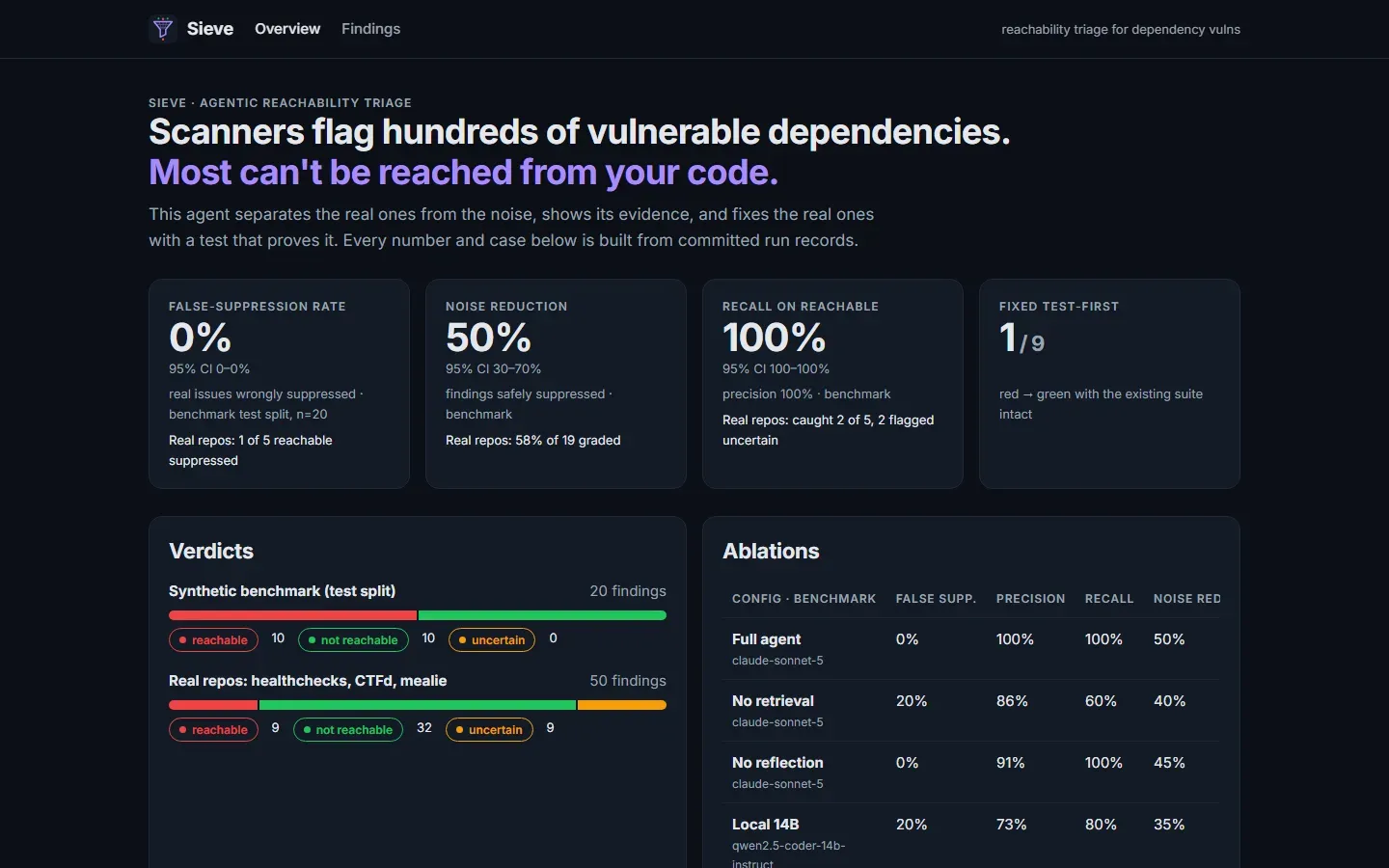
58% of graded scanner findings suppressed.

Sieve · 3 real Python apps, 19 human-graded findings; it also suppressed 1 of the 5 truly reachable ones

Sieve overview page: false-suppression rate 0%, noise reduction 50%, recall on reachable 100% and 1 of 9 fixed test-first, with verdict bars and an ablation table.

Scanners flag hundreds of vulnerable dependencies, and most can’t be reached from your code. Sieve is a LangGraph agent that decides which ones are real, shows file:line evidence, and tries to fix the real ones with a regression test that proves it.

  • Built a LangGraph pipeline: RAG over 640 advisories (Chroma, benchmarked against FAISS) plus AST call-path analysis, a structured Claude verdict and self-reflection. Retrieval alone lifts benchmark recall from 60% to 100%.
  • Ran test-first remediation in Docker: the LLM writes a failing regression test, then an upgrade or patch must turn it green with the target’s full suite intact.
  • Designed an honest eval: frozen configs, ablations, a local-model comparison, bootstrap confidence intervals, and labels drafted independently of the agent and reviewed by hand.

Built to be checked: every run record is committed, and rt eval regenerates every number with no LLM calls. Retrieval puts the right advisory in the top 5 98% of the time, and the right code 100% of the time.

truly reachable findings wrongly suppressed
1 of 5
real repos
right on a 20-case benchmark
20/20
benchmark built before any prompt existed
test-first fixes that went from red to green
1 of 9
with the existing suite intact

Blade 03 / GPU KERNELS

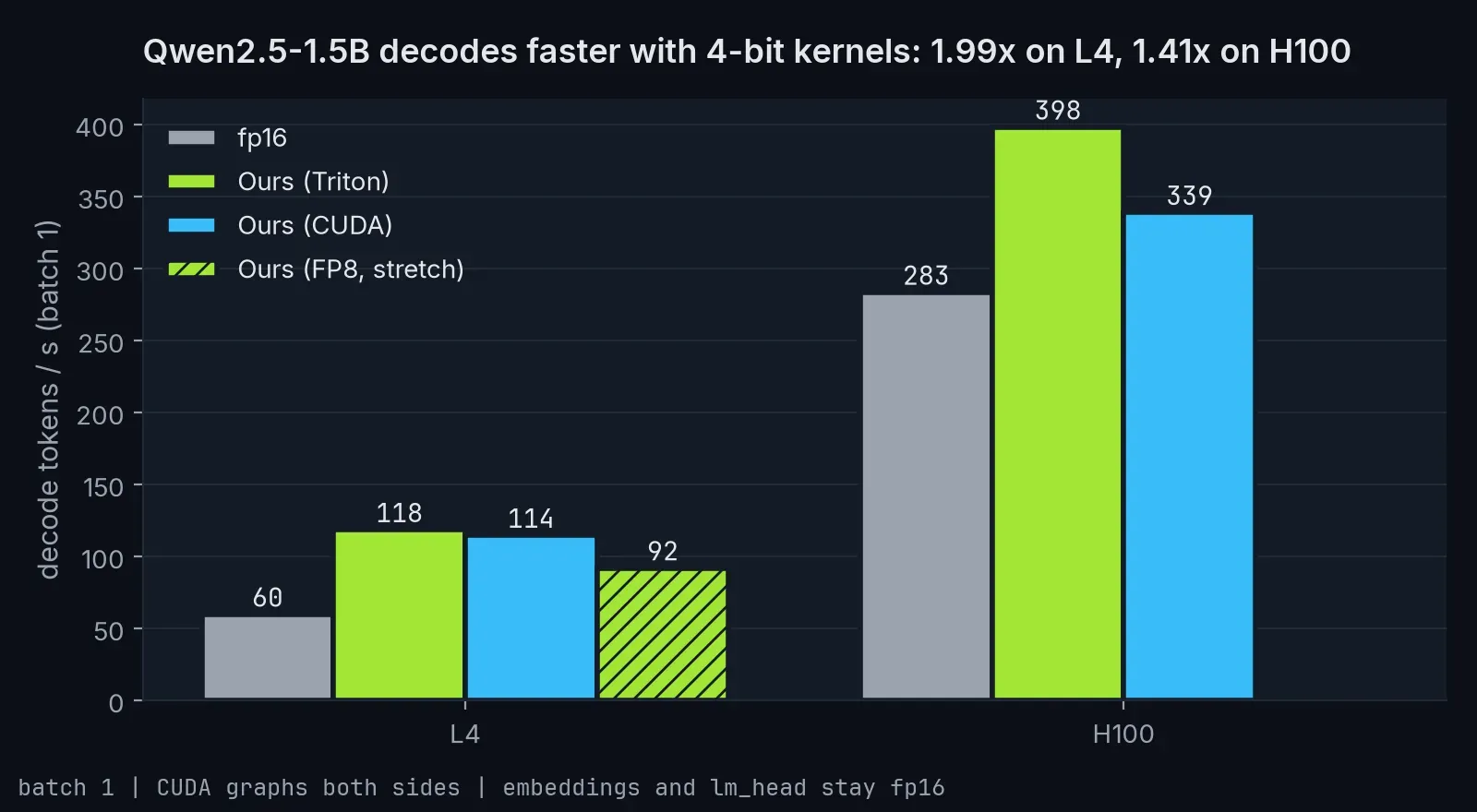
1.99x faster decoding than fp16.

llm-decode-kernels · Qwen2.5-1.5B, batch 1, NVIDIA L4 (1.41x on an H100)

Bar chart: Qwen2.5-1.5B decode speed at batch 1. On the L4, fp16 reaches 60 tokens per second and the Triton kernels 118. On the H100, 283 against 398.

Custom Triton and CUDA kernels for the memory-bound parts of LLM decoding: fused RMSNorm, fused SwiGLU, and a 4-bit weight matmul. Each one is tested against PyTorch, measured against the GPU’s limits, and swapped into Qwen2.5-1.5B.

  • Wrote a 4-bit weight matmul in Triton (batch-1 GEMV, split-K, tensor-core GEMM for prefill) and a CUDA C++ version. At batch 1 on an L4, Triton reaches 82-84% of peak bandwidth and runs 2.8x faster than fp16 cuBLAS (median over layer shapes).
  • Found and fixed three measurement traps: outputs hiding in L2 (171% of peak), a library’s tensor subclass under-sizing the working set, and eager timing choosing the wrong kernel path. Traced a profiler-vs-sustained gap to the L4’s 72 W power cap and cut the dequant to 4 instructions per weight, lifting bandwidth from 66% to 82%.
  • Swapped the kernels into Qwen2.5-1.5B with CUDA graphs: decode 60 to 118 tokens/s on L4 and 283 to 398 on H100, with the perplexity cost traced to round-to-nearest quantization, not the kernels.

Built for decode: at batch 1 the 4-bit matmul runs 2.8x faster than fp16 cuBLAS and even beats a plain device-to-device copy (82-84% of peak bandwidth against 77%). The whole project ran on an estimated $5.90 of GPU time.

of the L4's peak memory bandwidth
82%
4-bit decode matmul, batch 1
faster decoding on an H100
1.41x
Qwen2.5-1.5B, batch 1
estimated total GPU spend
$5.90
3.12 GPU-hours on Modal, cap $30

Blade 04 / MLOPS PLATFORM

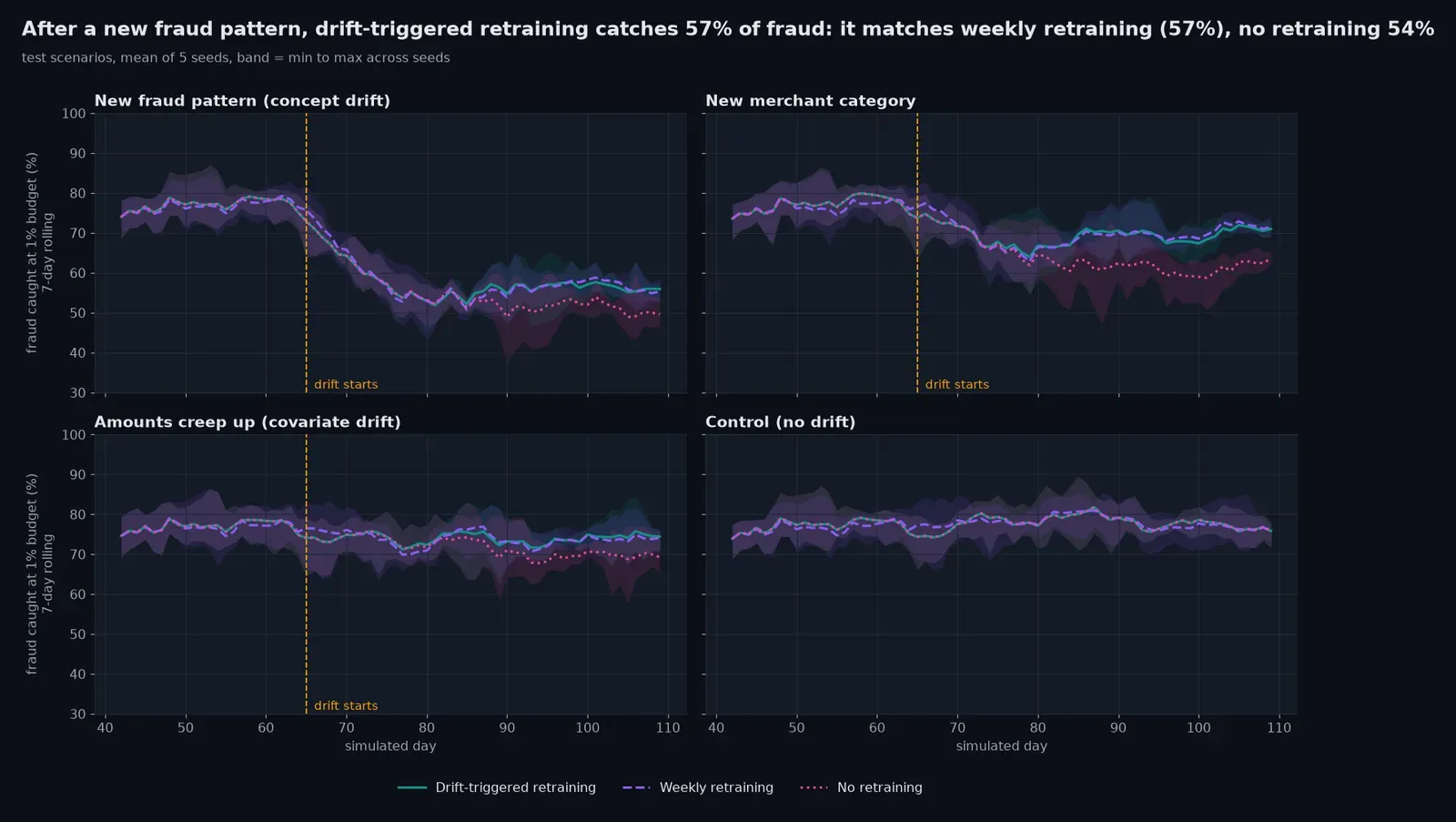
65% fewer retrains, same fraud caught.

Tideline · drift-triggered vs weekly retraining, 14 vs 40 retrains across four test scenarios, 5 seeds each

Four line charts of fraud caught over 110 simulated days, one per scenario. After drift starts on day 65, drift-triggered and weekly retraining track each other; no retraining falls lowest.

A fraud model’s whole lifecycle on a local Kubernetes cluster: it notices when fraud changes, retrains itself, ships the new model behind a canary, and is measured against simply retraining every week.

  • Built the full ML platform as code: Terraform creates a kind cluster with MLflow, Argo Workflows, Argo Rollouts, Prometheus/Grafana, Redis and an S3 store; it comes up from scratch in about 15 minutes and peaks at 8.6 GB of memory.
  • Wrote one feature definition with three implementations (PySpark for training, Redis for serving, numpy for a fast backtest) and checked them against each other on every retrain: Spark and the live service agreed to within 4e-12 on every retrain.
  • Ran a pre-registered experiment: tuned on dev scenarios, froze the settings, then reported the test scenarios with 5 seeds each, including where drift-triggered retraining did not help.

Production-shaped: a deliberately broken model was rolled back by the canary’s Prometheus analysis in 52 s while the champion kept serving, and the scorer handled 424 requests/s at 34 ms p50 with 0 errors.

retrains when nothing had changed
0
no-drift control; weekly retraining did 10
to roll back a deliberately broken model
52 s
Prometheus error-rate analysis during the canary
of lost catch recovered on a new fraud pattern
13%
the same as weekly retraining; labels arrive too late for either

Blade lights: replaying a recorded run from this project.

Blade 05 / LLM SERVING

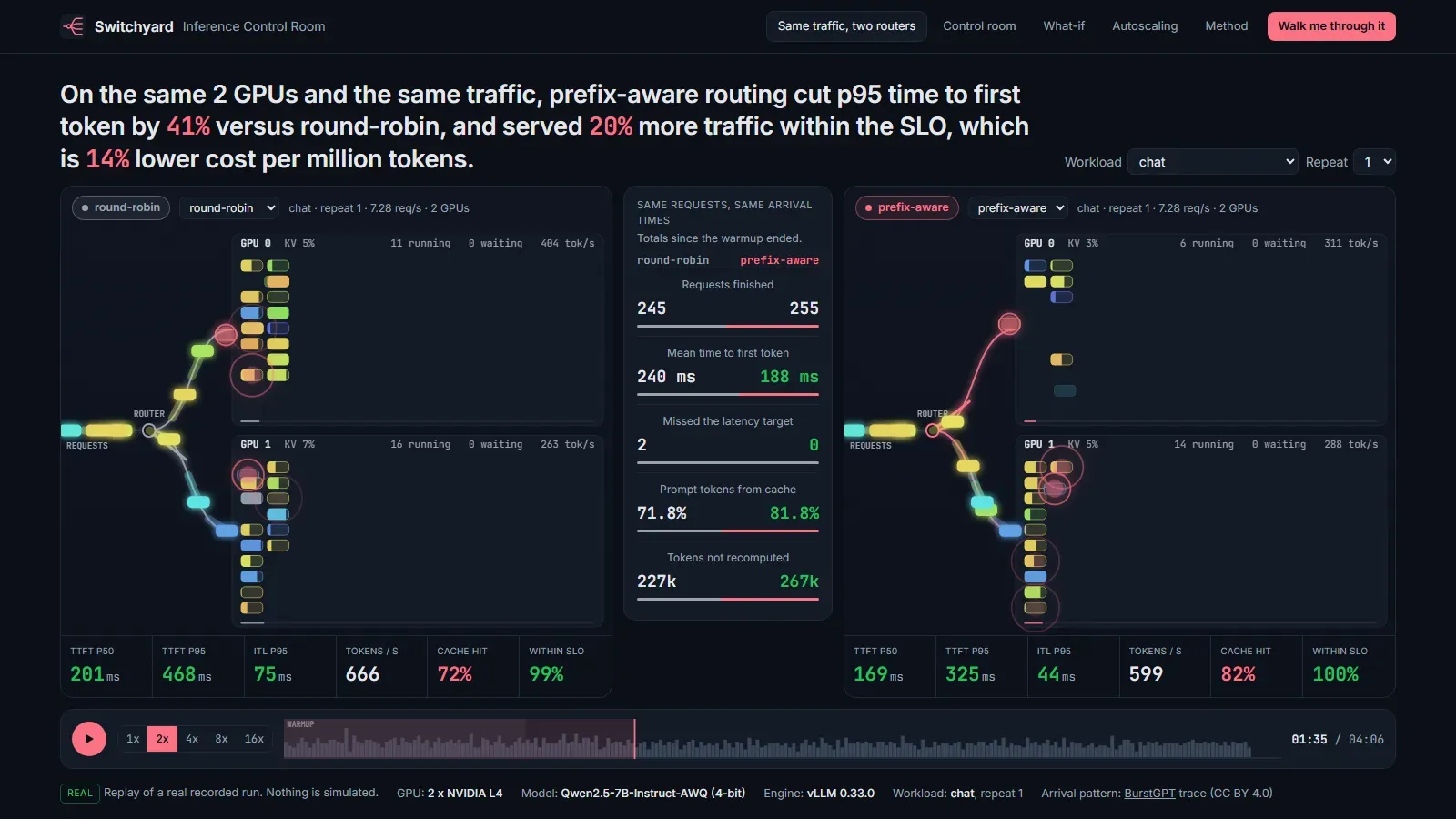
41% lower p95 time to first token.

Switchyard · prefix-aware vs round-robin routing, same 2 NVIDIA L4s, same traffic

The Switchyard control room replaying the same recorded traffic through round-robin and prefix-aware routing side by side, with latency and cache-hit numbers for each.

Serving LLMs is mostly a cost problem. Switchyard runs a small vLLM fleet on real traffic patterns, measures which serving techniques lower cost and latency, and replays every recorded request in an interactive control room.

  • Wrote a prefix-cache-aware router in Go and compared it with round-robin and least-loaded routing on identical traffic, with repeats.
  • Swept 10 server configs on an L4 and 4 on an H100 (quantization, speculative decoding, batch limits) and built an optimizer that picks the cheapest one for a latency target.
  • Built a control room that replays the recorded runs request by request, so every number can be traced to the requests behind it.

Room to grow: these gains come from just 2 GPUs. With 2 replicas, round-robin lands a follow-up on the right GPU half the time (a quarter of the time with 4), so the routing effect measured here is probably smaller than on 4 GPUs.

more traffic within the SLO
20%
same 2 GPUs, prefix-aware vs round-robin
lower cost per million tokens
14%
at the SLO, same 2 GPUs
lower cost per token on one H100 than one L4
54%
when there is enough traffic to fill it

Blade lights: replaying a recorded run from this project.

Earlier work

Smaller projects from before the rack, with their code and demos.

Open as a page (printable)

Quick view

Charlie González

Senior MLOps & AI Engineer · LLM Inference · ML Platform

  • 9+ years building data, ML and production systems
  • Washington, DC metro area
  • Now: Senior MLOps Engineer, Capital One

Top skills

LLM inference & serving
vLLM · KV cache · Triton · CUDA · FP8/AWQ · speculative decoding · Go
ML platform & MLOps
Kubernetes · Terraform · MLflow · Argo · Spark · AWS · CI/CD · observability
AI engineering & security
LangGraph · RAG · vector DBs · prompt-injection defense · evals · FastAPI

Proof, from the project files

  • Switchyard41% lower p95 time to first token (prefix-aware vs round-robin routing, same 2 NVIDIA L4s, same traffic)
  • llm-decode-kernels1.99x faster decoding than fp16 (Qwen2.5-1.5B, batch 1, NVIDIA L4 (1.41x on an H100))
  • Tideline65% fewer retrains, same fraud caught (drift-triggered vs weekly retraining, 14 vs 40 retrains across four test scenarios, 5 seeds each)
  • Sieve58% of graded scanner findings suppressed (3 real Python apps, 19 human-graded findings; it also suppressed 1 of the 5 truly reachable ones)
  • Bulwark84% of prompt-injection attacks caught (0.4% false positives, ~3,000 public and hand-written prompts, CPU only)

Contact

Open to senior MLOps, ML platform, AI engineering and LLM inference roles. Remote, or on-site around the DC metro area.

Esc

↑ ↓ to move · Enter to open · > for terminal commands